


In patriarchy women can do anything they fancy.
Provided, and as long as, men perceive it as low value.
This is the third of a 3-part series with more information on the examples of this pattern.
Covering filmmaking, dairy farming, seamstressing, rice farming, and restaurant kitchens.
This is 42 Sidenotes. The place for the incurably curious and endlessly fascinated. Where you’ll find multifaceted, opinionated observations, answers, and questions on life, the universe, and everything. Publishes every other week, usually on Sundays.
My article on the pattern of men butting in and taking over what women start, lives over on Deliberately Difficult & Laughing. It also tells you how turn it in your favor.
Researching that article I dug up 14 conspicuous examples of this pattern throughout history. Mindboggling illustrations of what happens when women show something men weren’t interested in has potential for money, status, or ego — or all three.
I’ve split them over a 3-part series because I don’t want to overwhelm you with the same infuriation I felt reading about how women were driven out.
Even if I don’t mention it, in all examples there’s one obvious underlying reason for why women were actively or passively driven out when men took an interest: men’s patriarchally conditioned gender bias against women.
Part 1 talked about programming, beer brewing and several medical fields.
Part 2 looked at filmmaking, dairy farming, seamstressing, rice farming, restaurant kitchens.
Part 3, this one, digs into botany, advertising copywriting, electronic music, cannabis.
#11: Botany in England

Men thought botany didn’t matter. So it was recommended to women.
For a century (1760-1860) botany was a women’s pursuit. Actively recommended to them as suitable.
They took Carl Linnaeus’s classification system, wrote educational texts, and published their views.
Their mistake?
Showing there was a science to it.
That caught the attention of men.
Male scientists — John Lindley, for example — started distinguishing between women’s botany for their amusement and botanical science. The latter, of course, “an occupation for the serious thoughts of men”.
Women continued contributing as teachers and collectors. But they were systematically pushed to the margins.
The mechanism?
The usual suspects.
Male rhetoric from the likes of John Lindley and others redefined the field.
Specialization and professionalization requiring formal academic education. Institutions actively closing (having closed) their doors to women. The combination meant women could not take on official research roles.
Active devaluing of textbooks, illustrations, and popular publication by women. Labeling them domestic tools rather than real science, successfully wrote female botanists out of the history of the field.
Sources
Ann B. Shteir, Cultivating Women, Cultivating Science: Flora’s Daughters and Botany in England, 1760 to 1860 (Johns Hopkins University Press, 1996)
#12: Advertising copywriting

“Women understand women” got them into advertising. Then came Mad Men.
Helen Lansdowne Resor was J. Walter Thompson’s (JWT) first female copywriter who pioneered emotional (and sex-appeal) copywriting. She was the first woman to create and run national advertising campaigns. And she ran the Women’s Editorial Department from 1910 to the 1940s at JWT.
Then came Mad Men. It’s a slang term for the advertising executives in the agencies clustered around Madison Avenue. Its golden age happened in the 1950s and 60s.
Women were still in the workforce but Mad Men executives were predominantly male.
Mad Men’s “Golden Age of Creativity” is lauded for shifting advertising from features to emotional and visual appeal.
Ironic as Helen Lansdowne Resor pioneered it.
And another example of men “scientifising”, in this case the use of emotion in advertising, and then, by design or bias, pushing women out of the lucrative “scientific” jobs.
Even more ironic: it was her husband Stanley Resor who more or less started that by hiring John B. Watson. His teachings on emotions gave it using them in ads a scientific image.
History favors the survivors.1
It’s how the successful female copywriters of the time — Helen Lansdown Resor, Shirley Polykoff, Mary Wells Lawrence, to name a few — got ousted from popular public memory of the period.
Another pattern we’ve seen before, for example in anesthesia (see part 1). My article doesn’t mention it (yet), but a friend’s daughter is training to be an anesthesiologist and she was astonished at its origins because all her textbooks depict males…
Sources
Doctoral research on the JWT Women’s Editorial Department, 1910-1945 (ProQuest)
Wikipedia, Helen Lansdowne Resor
#13: Early electronic music

Women pioneered electronic music. It didn’t count as music. Until…
Daphne Oram, Delia Derbyshire, Wendy Carlos, Éliane Radigue, Suzanne Ciani, Laurie Spiegel… embraced machines (what do you mean women aren’t technical), and utterly transformed music composition and production.
But it didn’t count as serious composition at the time.
I have no idea what makes composition “serious” and what doesn’t. It’s easy to scoff at anything new (remember Bill Gates — or was it Microsoft in general — saying the internet was never going to be big). And I wouldn’t be surprised if women pioneering it added weight to the urge to scoff.
When synthesizers grew commercially, the face of electronic music changed.
It became male.
The evidence is anecdotal. There’s no data on a causal relationship. But it does fit the pattern of males changing their minds when there’s money or status and ego to be had.
Sources
Sisters with Transistors (documentary, 2020)
Tara Rodgers, Pink Noises (Duke University Press, 2010)
#14: The cannabis industry

The “Grass Ceiling”. It’s happening now.
Medicinal use of cannabis started getting legalized in the late 1990s. Recreational use by adults started in the early 2010s.
Marijuana is still illegal under federal law, but the government does not prosecute anyone (including businesses), who follow state laws for medical or recreational use.
As a result the cannabis market has grown. The industry followed suit.
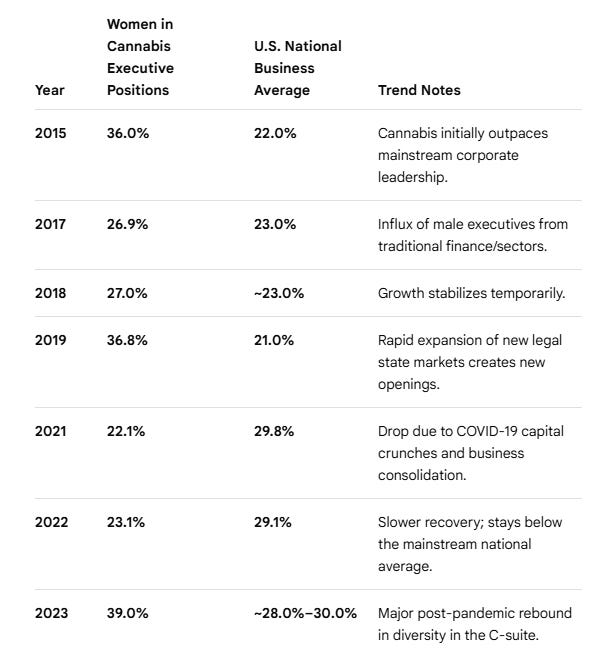
The share of women in executive positions is… volatile to say the least.
It started with a very progressive, significantly higher than the US business average, share of women executives. Competition becoming more pronounced, businesses increasingly favored men. A trend primarily driven by unequal access to institutional and venture capital. Gender biases very much at work in this.2 And a flooding of executives from other sectors smelling an opportunity.
Then Covid hit. Putting capital availability in a crunch and businesses into consolidation and risk aversion — read: in a crisis we want a man at the helm, because women are too … (you fill in the blank, you got enough adjectives to choose from).
Women’s executive share has rebounded since as a result of what MJBizDaily calls a major post-pandemic rebound in diversity in the c-suite.
The one good thing in all the numbers: apart from the Covid years (2021 and 2022), the share of women executives in the cannabis industry outshines the US business average. By miles.
Women are holding their ground when the world at large doesn’t throw spanners in the works with pressures getting businesses (‘s boards) to fall back on “proven” tactics.
I put proven in quotes deliberately.
Because proving something without the counter position every having meaningfully tested is no proof at all.
Not to mention the fact that quite often women are put in an executive position when men expect a no-win scenario. (What do you mean self-fulfilling prophecy.)
Sources
MJBizDaily, “Female, minority executives lose ground in cannabis industry”
MJBizDaily, “Chart: Women account for more than a third of marijuana business executives”
But wait… there’s more

This is the final article in a 3-part series.
Part 1 looked at programming, beer brewing, and several medical fields.
Part 2 covered botany, advertising copywriting, electronic music, cannabis.
After my article about the pattern went live on Deliberately Difficult & Laughing, Rosemary Bointon, drew my attention to pharmacy. It’s an illustration alright. Though witch hunts being aimed at women healers is a myth (popularized by a book in the 1970s and taken apart in 1990), it sure as heck wasn’t an encouragement. The story has an interesting twist at the end so I’ll probably create a separate bonus to the series for that.
Live long and prosper.

The phrase is the winners. I know. But in this context survivors sounded more apt.
It’s been shown — for example, in programs like “The Lion’s Den”, and that’s just an illustration of reality — that questions asked of women and men founders looking for capital are very different (by both female and male jury members). Men get asked questions about the opportunity for success. Women get asked about how they’ll avoid risks. Little wonder that women hardly ever get venture capital. The venture capitalists are rationalizing their already made biased decisions with loaded questions.